Thursday, 17 June 2010

Enjoy your Summer Holidays!

Dear students,

The school year is almost finished. It's been a pleasure having had you as my students for nine months. I hope you have learned new things and I wish you keep on learning. In the future you'll see how important it is to speak foreign languages. You know how to contact me for whatever you want or need. I really would like to have you as my students next year.

Have a good summer!

Monday, 31 May 2010

Have to

As you know, we have learnt how to use have to to express obligation and don't have to to refer to lack of obligation. Here you have another explanation with interesting activities for you to practise.

Let's Review Conditional Sentences

We shouldn't have any problem using conditional sentences (type 1). In case you need further practice or clarification, you can visit this website and read the explanations and do some activities. Remember we have just seen Type 1 Conditional Sentences. There are another two types, in case you want to go into further details. I hope it helps!

Let's Visit Devon Island!

As you know, these days we have been reading about the project The Mars Society is developing on Devon Island, which according to scientists have many things in common with Mars. Here you can learn more things about this society, the island and the planet. Moreover, you can also enjoy this video and see that they are in fact really similar!
Would you like to be a volunteer for the project?

Monday, 24 May 2010

Forms for the Future

Lately we have learnt about the three different forms English has to refer to future time: be going to, Present Continuous and 'will'.

For an explanation and activities on be going to, click here.

Remember that we use Present Continuous to talk about totally planned activities. You can review it here.

But we can also refer to the future using the modal auxiliary verb will.
You can click here for further explanation on this topic. Moreover, you will have the opportunity to do some more activities. I hope it helps!

Sunday, 16 May 2010

In the Future . . .

As you know, these days we are learning how to make instant decisions and future predictions with will. Here you can see a video and listen to a song Mariló has chosen for you to work with.

A new final act for Romeo and Juliet by such talented actors!

Last Tuesday we enjoyed a new final act of Romeo and Juliet, written and performed by a great company of actors. Here you can see the video. Congratulations! You did a good job!


Sunday, 9 May 2010

Students' Posters on Shakespeare and Elizabethan Period

Last Friday all the students made a presentation of the posters they had designed. As you know, this was one of the activities in the WebQuest they have been doing for a couple of weeks. The posters are hung on the school walls but here you can also see them!

Saturday, 8 May 2010

Shakespeare in Love

Last Tuesday we saw the film titled Shakespeare in Love. It gave us a great opportunity to see the main aspects of the Elizabethan period: people, streets, theatres, performances, etc.

I include below the worksheet we used before watching the film, which includes a plot synopsis.


Did you like the film? Why? Please send a comment giving your opinion.

Shakespeare in Love

Wednesday, 5 May 2010

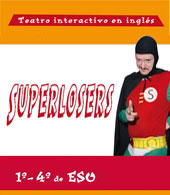
Superlosers!

Today we enjoyed Superlosers, the adapted play we attended. You were a wonderful audience and I think everybody had a really good time. Congratulations!

Here is the worksheet we used to introduce the play and sum up the plot:

Super Losers
And here you can have a look at some pictures:

Thursday, 22 April 2010

Book Day and Copyright Day

On 23 April we celebrate Book Day and Copyright Day. But do you know why? This day is the anniversary of the death of three important authors around the world: William Shakespeare, Miguel de Cervantes and Inca Garcilaso de la Vega. All of them died on 23 April 1616 (although there are some days of difference because some countries followed the Julian calendar and others the Gregorian one). That is the reason why UNESCO chose this day to encourage people to enjoy reading.

In fact, we are not celebrating a particular day, but the whole month, by working on the WebQuest on Romeo and Juliet and Elizabethan England. Very soon we will see the final projects and we will enjoy a new final act of the play performed by our own company of actors. I can't wait for it!

Good WebQuest Work!

The students keep on working on the WebQuest on Romeo and Juliet and Elizabethan period and they are doing a great job, so congratulations to you all!

This is just a quick reminder with all the groups and pairs:

GROUP A
- Biographers: Mercedes and Alberto
- Work researchers: Mª Jesús and Carolina

GROUP B
- Period historians: Patricia and Antonio
- Place historians: Virginia and Álvaro
- Everyday life historians: Laura and Jairo
- Celebritry journalists: Clara and Saray

GROUP C
- Architects: Jesús and Marta
- Literary critics: Ana and Manuel Tejero

GROUP D
- Stratford-upon-Avon travel agents: Juan Manuel and Raquel
- London travel agents: José Antonio Cordero and Daniel

GROUP E
- Company of actors: María, Jenifer, Manuel Caro, Desirée, José Antonio García and Benito

Monday, 5 April 2010

A WebQuest: Our Project for April


As you know, we will work on a WebQuest on Shakespeare and Elizabethan theatre after having read Romeo and Juliet.You can click here to go direct to the website.

Sunday, 4 April 2010

Easter Egg Hunt


As you know, people in the United Kingdom and the United States go egg hunting to celebrate Easter. Here you can see how they enjoy the hunt!


Thursday, 1 April 2010

April Fool's Day


April Fool's Day, or All Fools' Day, is the first day of April. It is a traditional day for playing pranks on unsuspecting people. In many countries, including the United States and the United Kingdom, people play tricks on others. A favourite joke is to send someone on a fool's errand (a search for something that does not exist), or to get people to believe ridiculous things. The victim is called an April Fool.

No one knows where the April Fools' custom began. The origin is uncertain but may be related to the arrival of spring in late March, when nature "fools" humanity with changes in weather. Another explanation has to do with the change to the Gregorian calendar in 1582, which moved New Year's Day to January 1.

The tradition originated in France and Great Britain and it was introduced into America in colonial times.

The French call April 1 "Poisson d'Avril" or "April Fish". French children sometimes stick a picture of a fish on the back of their schoolmates, crying "Poisson d'Avril" when the prank is discovered.

Thursday, 25 March 2010

Easter

Next week we'll be enjoying our Holy Week vacation, which finishes with Easter. What do you know about Easter? If you want to learn about its origins (both religious and pagan) and about the way in which it is celebrated in different parts of the world, read the following text and do the activities proposed in the worksheet.
Moreover, you can do many other types of interesting activities, both on paper and on line, if you click here.
Have a happy holiday!

Easter

Thursday, 18 March 2010

St. Patrick's Day


Saint Patrick’s Day is celebrated each year on March 17th. In Ireland, Saint Patrick’s Day is both a holy day and a national holiday. Saint Patrick is the patron saint of Ireland because he brought Christianity to the Irish.

According to legend, Saint Patrick used a shamrock (a type of clover) to explain about God. The shamrock has three leaves on each stem. Saint Patrick told the people that the shamrock was like the idea of the Trinity – that in the one God there are three divine beings: the Father, the Son and the Holy Spirit.

Although it began in Ireland, Saint Patrick’s Day is celebrated in countries around the world. People with Irish heritage remind themselves of the beautiful green countryside of Ireland by wearing green and taking part in the festivities.

Saint Patrick’s Day is usually celebrated with a parade. The one in Dublin, the capital of Ireland, is very famous. But the one in New York City is one of the biggest. It lasts for hours.

One tale about Patrick is that he drove the snakes from Ireland. This is a metaphor for his bringing Christianity to Ireland and driving out the pagan religions. It’s true that Ireland has no snakes, but this has to do with the fact that Ireland is an island and being separated from the rest of the continent the snakes couldn’t get there.

Play a game here and have good luck! You can also read poems and listen to songs for this special day here.

Sunday, 7 March 2010

Present Perfect Simple

As you know, in the last unit we have learnt how to form and use the Present Perfect Simple tense.

Here you can read a funny introduction to the topic and you can also review its form and use, apart from doing some interesting activities.

International Women's Day

International Women's Day (8 March) is a global day celebrating the economic, political and social achievements of women in the past, present and future. In some countries like China, Russia, Vietnam and Bulgaria, this day is a national holiday. If you want to learn more about this day, you can click here.

This is the message the Secretary General of the United Nations has sent to the world.


And here goes a short tribute to some of the many important women throughtout history. Do you know them?

Monday, 1 March 2010

Europeans Care for the Environment

As you know, these days we are working on a didactic unit on the European Union and the care of the environment. Here you are a copy of the activities (this time in full colours, more attractive than the photocopy I gave you). First of all I include the slide presentation for activity 3.a.a and the links to the websites that are necessary for other exercises.


This is the slide presentation for activity 3.a.a:


These are the Internet links:

Europoean countries (activity 1.e.c.)

Global warming video (activity 3.i.)

Energy video (activity 3.j.a.)


Carbon calculator (activity 3.j.b.)

Party listening (activity 3.k)

Final quiz (activity 5)

And here is the worksheet:


Didactic Unit. Europeans Care for the Environment